
Access control and turnstile integration connects the physical-security stack to the digital-signage layer so that a card tap, a QR scan, or a biometric check turns into a relevant on-screen message in the same second. Smart turnstiles publish events over an HTTP API; SpinetiX EMP-III players subscribe and switch content per cardholder identity. Built into a single integration, the same architecture serves office lobbies, metro stations, sports venues, and high-security industrial sites — and inherits the antipanic egress and emergency broadcast paths the venue's life-safety system already requires.
The reference deployment for this integration was demonstrated at Securika Moscow 2026, where SpinetiX hardware was paired with smart turnstiles from Infomatika across four live zones. Because the integration is API-driven and the turnstile vendor side is well-defined, the same pattern transfers to any access-control product with a comparable controller — including the readers and gates used across UAE, Saudi, Qatari, Bahraini, and Türkiye-based projects.
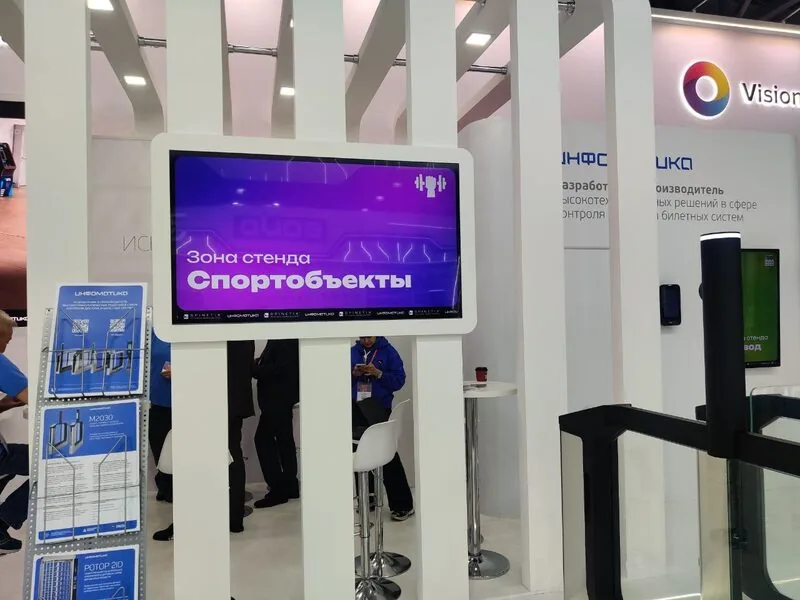
How a card tap becomes a screen update
The integration runs on a thin HTTP contract:
- A user presents a card, scans a QR, or completes a biometric check at the turnstile.
- The turnstile controller authorises the action and, in parallel with releasing the gate, sends an authenticated HTTP request to the player's RPC endpoint with the card identity and an event tag.
- The SpinetiX player resolves the identity against an Elementi data feed (LDAP, CRM, room-booking, or a flat directory), picks the matching scene from the content project, and switches in well under one second.
- The screen displays the personalised content. The same loop also pushes an audit event to the venue's logging system.
Nothing in this contract is venue-specific. The same call returns a corporate greeting in an office lobby, an accessible-route hint in a stadium, a train timer in a metro, or the start of a safety briefing in a refinery. What changes is the content project — authored once in Elementi per venue, with the data feed describing who is who.
Hardware and software demonstrated
- iQnetiX EMP-III players — driving the screens. Fanless, signed firmware, 10-year service life. The same SpinetiX hardware family used at Burj Khalifa's Dubai Fountain.
- Elementi — content authoring and publishing. Holds the per-venue content project, the directory feed, and the rules that map identity to scene.
- Smart turnstiles (Infomatika): Flagman Lite, M2030, Vector Plus / Vector Gate, Rotor. Card readers, IP cameras, QR scanners, biometrics, antipanic, alcohol and explosives detection — chosen per venue type.
- Digital screens — direct-view LED, LCD video walls, single-screen displays. Resolution and aspect are decided per content brief; the player drives any HDMI-capable display.
Watch the integration in action
The four-zone live demonstration from Securika Moscow 2026, narrated end-to-end:
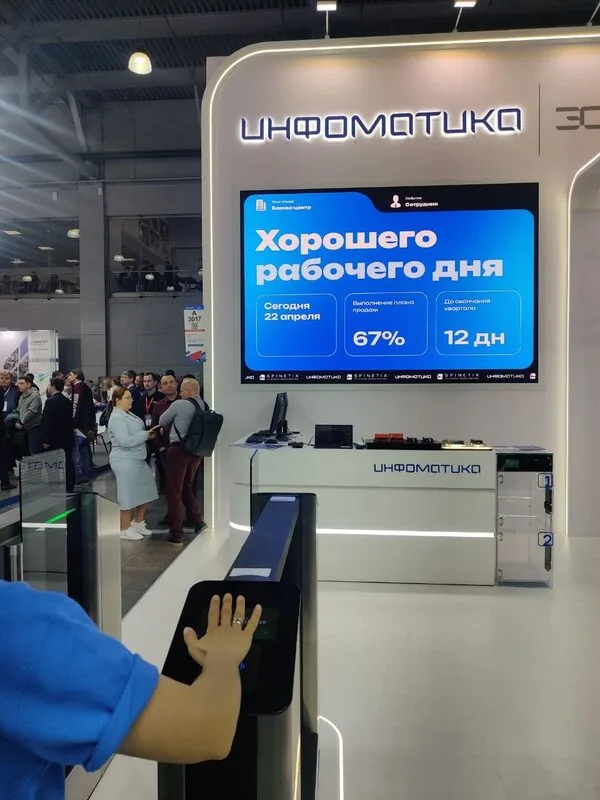
Office lobby — Flagman Lite + EMP-III + LED
A visitor or employee taps a card. The Flagman Lite turnstile opens and emits an event; the SpinetiX player on the lobby LED switches scene immediately. Visitors see the wayfinding hint that matches their appointment — meeting room, host name, floor. Employees see the daily corporate brief — KPI snapshot, calendar of internal events, town-hall reminder, named birthdays. The same screen runs a generic loop in standby; the personalised scene is only on for the seconds after a tap.
Transport — M2030 turnstile, Moscow Metro
The M2030 turnstile, paired with EMP-III players, lifts station throughput by 40%. The signage layer turns the throughput gain into a passenger-experience gain: when a passenger arrives a moment after the train has departed, the screen above the platform shows a count-down timer to the next train and a contextual offer — a discount at the platform-side café, station safety reminder, or a service-staff message such as a shift briefing or transport-worker holiday greeting. The friction of a missed train converts into useful information and a small incentive to wait.
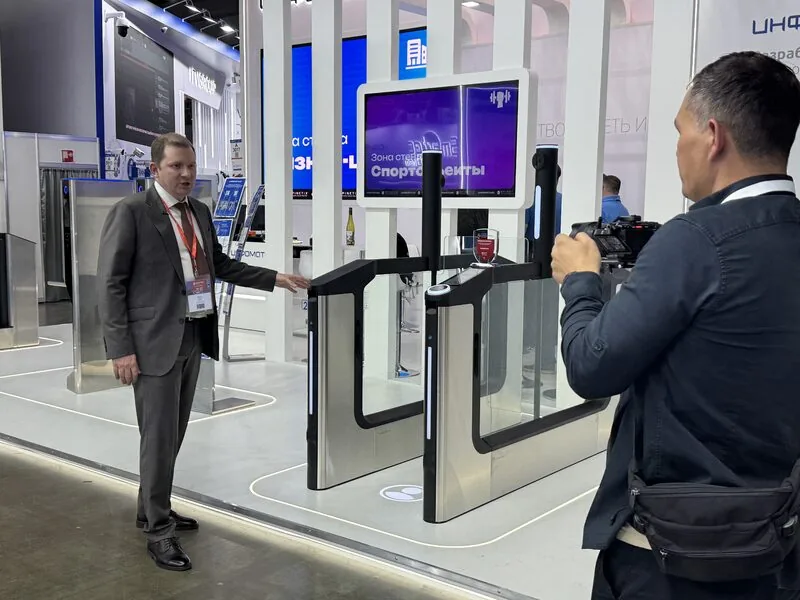
Sports venues — Vector Plus / Vector Gate, antipanic egress
Stadium and arena gates use Vector Plus and Vector Gate turnstiles — IP camera, QR scanner, card reader, and an antipanic mode that releases the gate immediately on emergency. SpinetiX personalises the wayfinding the second a fan taps in:
- VIP ticket holder → directions to the lounge, with VIP-tier branding on the panel.
- Visitor with reduced mobility → a message that an assistant has been alerted and is on the way, with the route to the accessible seating clearly highlighted.
- General-admission fan → fastest route to their stand and the nearest concession.
- Staff and stewards → routing to their post, with operational notes for the shift.
On the operational side, the same event tells the steward team which gate the assistance request came from. In the Middle East, dust- and humidity-rated variants are available for open-air stadiums in the Gulf — the same architecture, weather-rated for the climate.
Industrial — Rotor full-height turnstile, safety briefing on tap
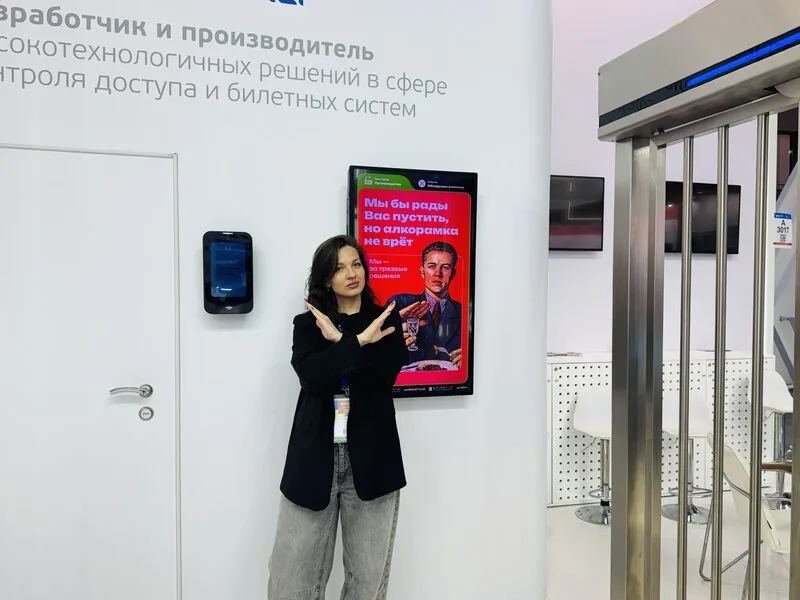
For refineries, plants, and high-security industrial sites, the Rotor full-height turnstile integrates explosive-trace detection, an alcohol-level test, and biometric verification. The card-tap sequence is layered:
- Card tap → screen switches from the standby loop to the safety-briefing introduction.
- PIN entry → check-list step 2; the screen advances.
- Alcohol-level check → step 3; on a fail, the gate stays locked and the screen switches to the supervisor-call protocol.
- Biometric scan → step 4; on success, the gate releases and the screen ends with the on-site navigation hint.
- Anomaly → emergency broadcast pre-empts everything; the screen carries the evacuation route and the gate releases under antipanic.
The safety briefing is no longer a printed laminate at the gatehouse — it's frame-accurate multi-step content that every entrant sees and every entry timestamps to the audit log.
Why this matters for Middle East projects
The same integration is shipping to UAE, Saudi, Qatari, Bahraini, and Türkiye-based projects via Media La Vista. The architectural fit is exact: most secure (the integration runs entirely on the customer's network, no cloud egress required), on premises (Elementi and the players sit inside the venue's segmented network), 10-year hardware lifespan (EMP-III and the iBX series are signed-firmware, fanless, built for the long run), automation (one card tap fires the right content with no operator in the loop), and local support (Tier 1–3 from Media La Vista's partner network in Riyadh, Dammam, Doha, Manama, and Dubai).
Architectural takeaways
- Integration of access control and digital signage raises both security and information density on the same screens. One control plane, two outcomes.
- Smart turnstiles and SpinetiX players are IoT devices on a clean API contract. They integrate with any system that can call HTTP — SCUD, BMS, fire alarm, ticketing, ERP, room booking, or a custom controller.
- SpinetiX content is the last-mile of the security stack: fast, deterministic delivery of the right message to the right person — by definition, the moment they arrive.