
/ Digital Signage as Investment /
Digital Signage Is No Longer a Purchase. It's an Investment — and That Changes Who You Buy From.
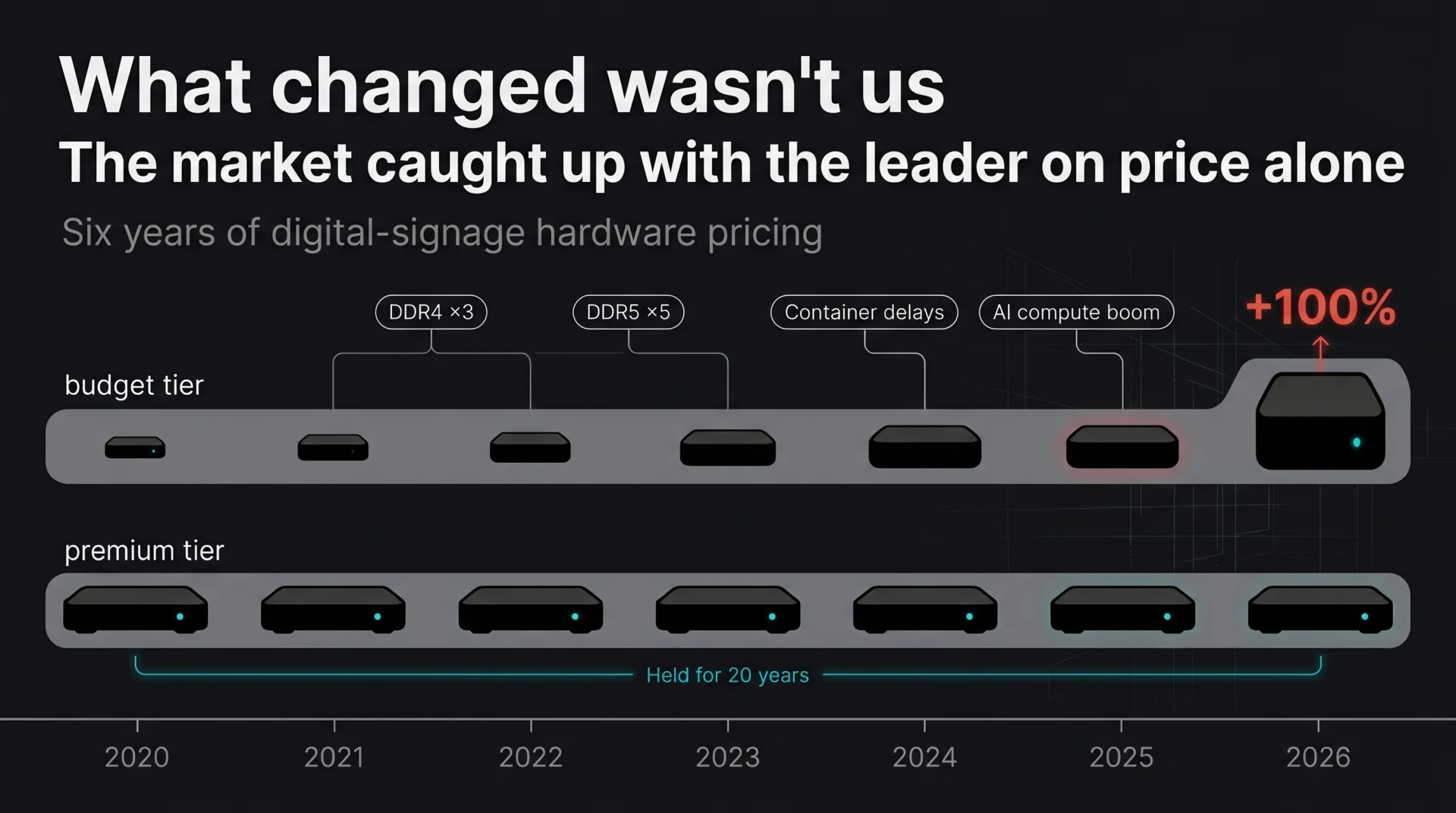
The cheap tier of digital signage ended in May 2026. Hardware prices doubled. The price-security window collapsed from years to three months. The gap between budget and premium narrowed sharply — but the lifecycle gap did not. SpinetiX has held the premium line for two decades. The market just arrived where we have always been.
For twenty years, the question in digital signage procurement was: do we buy SpinetiX, or do we buy something cheaper?
In May 2026, the question changed.
The cheaper option doubled in price. The vendor lifecycle behind it did not lengthen. The compliance regimes around it tightened. And the audience now expects a digital surface in every venue that wants to look modern. The decision is no longer between premium and budget. The decision is between an investment that pays back over a decade — and a purchase that becomes a liability before it depreciates.
This article is the case for treating digital signage as the investment category it has now become.
What Changed in May 2026
The industry analyst invidis published a hard piece on 8 May 2026 titled "Media Player Prices: How AI and Geopolitics Are Hitting Digital Signage Hardware". The numbers, in one paragraph: hardware prices across major signage-player vendors rose up to 2× since the start of 2026; entry-level player prices "may have doubled" in some cases; DDR5 memory rose by a factor of five; DDR4 tripled; and price-security windows across the industry collapsed from approximately four years of stability to about three months. SD-card prices now fluctuate "on a near-daily basis." Container ships routed through the Middle East faced delays attributed to regional conflict.
Three days earlier, on 5 May 2026, the AVIXA Digital Signage Power Hour — moderated by invidis MD Florian Rotberg, with Eric Oliver (Poppulo), Joe Whitesides (AVI-SPL), and Nita Odera (Blue Rhine Industries) — separately confirmed the same memory shock from the integrator side: DDR4/5 has roughly quadrupled in twelve months, sustainability arguments around component count are now economic, and the Middle East panelist confirmed real cyber and physical infrastructure attacks tied to regional events.
Two independent sources, one direction. The cheap tier of digital signage hardware no longer exists.
The Numbers
What twelve months did to a market that hadn't moved in a decade
Hardware prices across major signage-player vendors in 12 months
Entry-level player prices in some cases
DDR5 memory price multiplier in 12 months
DDR4 memory price multiplier
Industry price-security window — was ~4 years
SD-card price volatility cadence
Sources: invidis, "Media Player Prices: How AI and Geopolitics Are Hitting Digital Signage Hardware" (8 May 2026); AVIXA Digital Signage Power Hour (5 May 2026).
The Cheap-Tier Collapse
For most of the last decade, the buyer's calculus was simple. A budget player cost roughly one-quarter to one-third of an industrial-grade SpinetiX HMP, did 70% of the job, and was treated as disposable — replaced every two to three years when its OEM moved on. The model worked because the unit cost was low enough that the abandonment cycle was tolerable.
That model is now broken. The unit cost has doubled. The abandonment cycle has not extended. The buyer is being asked to pay twice as much for an asset that is still going to be unsupported within twenty-four months and uninsurable within thirty-six.
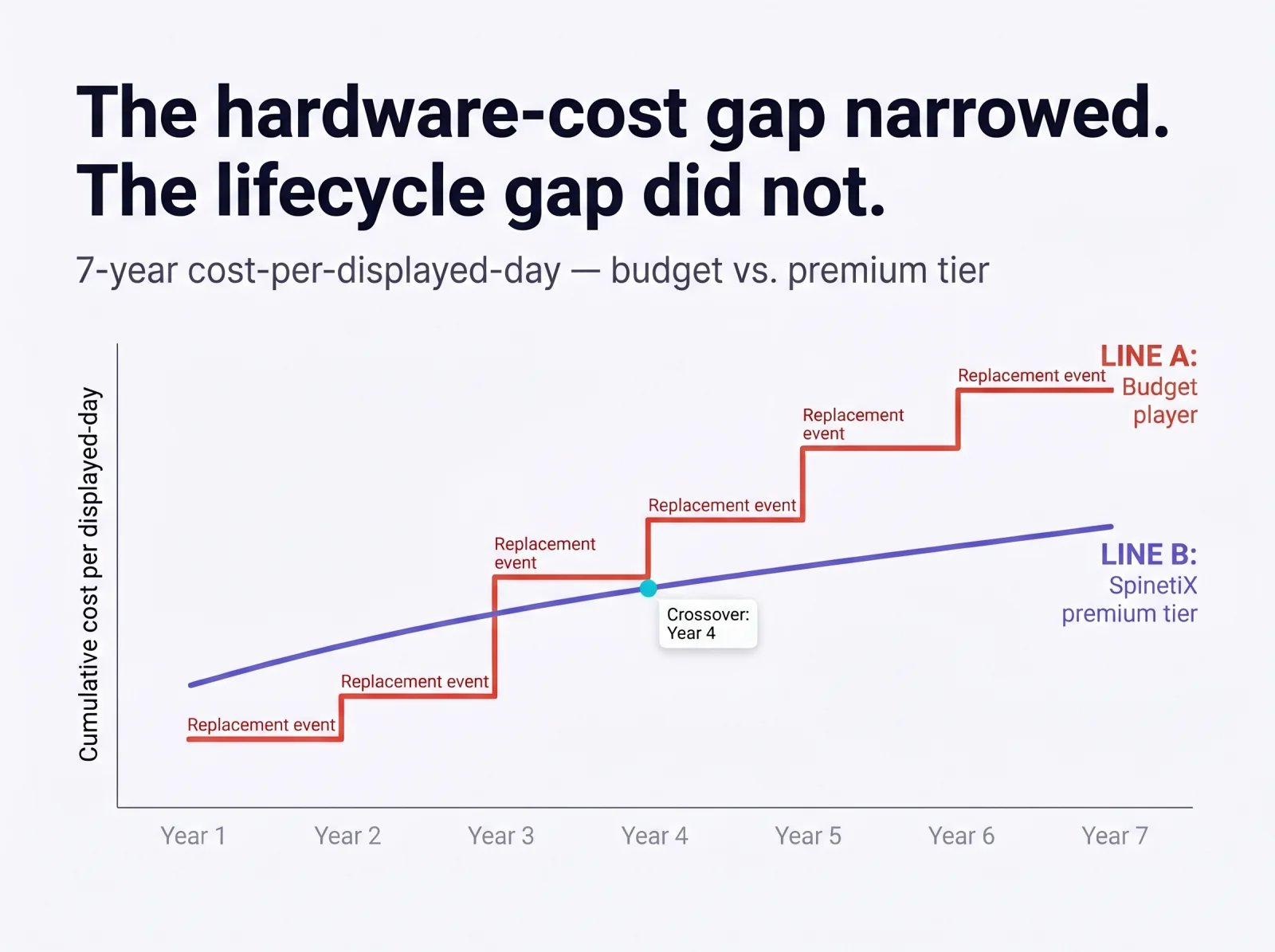
Premium-tier SpinetiX hardware also moved within the broader market band — the same memory and shipping pressures land on every player vendor. But the lifecycle did not change. SpinetiX HMP and iBX players are engineered for a 7–10 year service life, with patched firmware throughout, parts availability across multiple compatible generations, and a documented hardware failure rate below 1% over a ten-year window. The hardware-cost gap between budget and premium narrowed sharply. The lifecycle gap did not.
Run that math out to cost-per-displayed-day across a 7-year deployment, and the budget tier no longer wins. It hasn't for a year. The May 2026 price shock is when the gap stopped being deniable.
SpinetiX Has Been the Premium Tier Since 2007. The Market Just Arrived.
It is worth saying out loud: SpinetiX did not reposition. We did not raise prices in panic. We did not relabel a budget product as a premium one. We have been the top of the market for the entire history of dedicated digital signage hardware, for twenty years, on the same architectural argument we made in 2005: that a screen behind which sits real money — a hospital, an airport, a bank, a stadium, a regulated venue — needs an industrial player on a purpose-built operating system, supported through a regional accountability chain, not a consumer-grade box behind a cloud login.
For twenty years that argument carried a price premium that was easy to undercut. Now the market's bottom moved up. Our line did not move down. The result is that the customers who used to compare us to a $300 disposable are now comparing us to a $600 disposable — and the architectural arguments that always justified the premium have stopped being optional.
This is not a victory lap. It is a description. SpinetiX is now the rational choice on cost-per-displayed-day, on lifecycle, on regulatory readiness, and on supply-chain stability. The market arrived. We have always been here.
What "Investment" Actually Means — Five Things You Are Buying
When digital signage was a commodity purchase, you bought a SKU and a delivery note. When it became an investment, you started buying five things at once — and only one of them is the box on the wall.
Patched Firmware for the Lifetime of the Deployment
The AVIXA Power Hour panel was direct: a 24-month signage SoC update cadence is "unacceptable." The bar Microsoft is now pushing across the Android signage market — quarterly mandatory security patches via MDAP — is the bar SpinetiX has shipped against for two decades. Firmware lifecycle is not a feature you announce. It is a contract you keep, every quarter, for a decade. When you buy a player whose vendor patches it twice in its life, you are buying a future remediation project, not a fleet.
A Vendor Who Will Still Exist in 2033
White-label SoC OEMs come and go on quarterly cycles. The OEM that supplied last year's "enterprise Android signage box" is often a different legal entity by the time you need a replacement unit. SpinetiX has shipped four compatible hardware generations across eighteen years — every player from 2007 onward has a successor that drops into the same fleet without rebuilding content. When a player fails in year seven, you replace it. You do not replace the project.
A Regional Partner Who Finishes What They Started
Buy-and-kick-off died with the cheap tier. A signage rollout in 2026 spans regulatory approvals, sectoral compliance, content lifecycle, integration with operational systems, and ongoing training of operator staff. A vendor or distributor who disappears at PO closure leaves the customer carrying every one of those obligations alone. Media La Vista has operated as the regional Master Distributor for SpinetiX since 2007, with our own ME Academy training programme, named Tier-1, Tier-2 and Tier-3 engineers in-region, and a 14-service operational scope that runs from pre-sales through end-of-life. That is what "investment" looks like on the partner side.
A Cryptographic Stack That Passes Cyber-Insurance Underwriting Today
The AVIXA Power Hour identified an emerging failure mode that procurement teams have not fully absorbed: cyber-insurance underwriters are starting to refuse coverage for fleets running stale Chromium engines (typical SoC vintages of v50–v70 against a modern v150). When the insurer says no, the fleet stops being a buying decision and becomes a compliance problem. SpinetiX DSOS does not depend on a browser engine for its security posture; it is a purpose-built single-application firmware with no general-purpose attack surface. We treat the discipline of cybersecurity in detail in the companion article on cybersecurity as a discipline.
Compliance Evidence Pre-Built for the Frameworks You Are Bound By
Regulated environments — government, healthcare, banking, education, transport, public-safety — increasingly require evidence that the signage layer satisfies sectoral controls. The cheapest tier of player ships with no audit artefacts at all. SpinetiX maps cleanly to ISO 27001, UAE PDPL, Saudi NCA ECC, sector-specific civil-aviation and civil-defence frameworks, and the new Dubai Law No. (2) of 2026, which takes effect in June 2026 and attaches fines of up to AED 2 million to specific public-safety signage failures. Compliance evidence is a precondition for the contract, not a benefit you discover after deployment.
The Test Case
Dubai Law No. (2) of 2026 — Fines up to AED 2M, in effect from June 2026
If you want a single, concrete reason that the cheap tier is now the expensive tier, Dubai Law No. (2) of 2026 is it. The Law requires every commercial venue in Dubai to operate emergency safety signage that fires within seconds, in Arabic and English, with location-specific evacuation routes, even when the internet is down. Fines for non-compliance run up to AED 2 million.
This is not a hypothetical. It is the regulatory floor for any commercial space in Dubai from June 2026 onward. A budget SoC player whose vendor patches it twice a decade, whose firmware does not support API-triggered emergency overrides, whose offline behaviour is undocumented, and whose Arabic rendering is "best-effort" cannot pass this test. The price you save on the player is not commensurate with the AED 2M downside.
SpinetiX meets every one of the Law's requirements out of the box — content storage local to the player, hardened cryptographic identity, native Arabic rendering, API-triggered overrides from any fire-alarm or BMS system, signed firmware, and a regional Tier-1 support obligation. See the full requirement-by-requirement mapping →
You Cannot Skip Digital. The Younger Audience Will Notice.
One response to a doubled hardware bill is to defer the project. This is the wrong move and the AVIXA panel was clear on why. Younger audiences treat the absence of digital surfaces as the absence of brand modernity. A retail venue without digital signage now reads as old-fashioned. A hospitality space without it reads as un-upgraded. A transit hub without it reads as unsafe. The decision to skip digital is now a decision to forfeit recognisability with the demographic that drives discretionary spending.
The same panel made a separate point that pairs with this one. Generative-AI "pretty pictures" — the kind of synthetic content that a low-effort signage operator now defaults to — are increasingly being spotted by younger audiences as inauthentic, and damage brand trust when they are. So the brief on the buyer is firm in two directions at once: the screens must be there, and the content on them must be real.
Both of those requirements push toward investment-tier infrastructure: hardware that runs reliably enough to be relied upon, content tooling capable of expressing brand voice at scale across localisations, and operational discipline that authors content rather than autoplays templates. SpinetiX's data-driven content engine, Elementi authoring suite, and 250 widget-constructors are built for exactly this discipline.
The Ten Questions to Ask Any Signage Vendor in 2026
Score honestly. The questions are written so that even our competitors' customers can use them — we score honestly because we know we win on them.
- 01What is the documented hardware failure rate over a ten-year window, in production, across thousands of deployed units?
- 02How frequently is firmware patched, and is the cadence contractual rather than aspirational?
- 03Will this exact SKU still be supported, with parts and firmware, in 2033?
- 04Who in my region answers a 02:00 call, and what is the response SLA in writing?
- 05Does the operating system include a browser, an app store, or any user-installable runtime — and if so, what is its CVE exposure?
- 06What is the current cryptographic stack version, and does it pass cyber-insurance underwriting today?
- 07Can the player run offline and continue to display correct content if the cloud or the WAN disappears?
- 08Is emergency-content override implemented as a documented, vendor-supported API — not a workaround?
- 09What regulatory frameworks does the support contract explicitly map to (ISO 27001, UAE PDPL, NCA ECC, civil-defence codes, sectoral rules)?
- 10Does the vendor or partner provide post-deployment training and certification for my operator staff, in scope and on contract?
You are buying a SKU. Treat it as disposable and budget accordingly.
Serious commercial. Adequate for non-regulated estates with low operational risk.
Investment-grade. Suitable for regulated, mission-critical, and long-lifecycle deployments.
If It's an Investment, Treat It Like One
The market just told the truth out loud: the cheap tier of digital signage hardware is over. Doubled prices, three-month price-security windows, two-year vendor abandonment, stale browser engines refused by cyber-insurance underwriters. None of that is changing back.
The choice you have, as a buyer in 2026, is not between premium and cheap. It is between an investment that pays back over a decade — through patched firmware, regional support, supply-chain stability, and compliance readiness — and a purchase that becomes a liability before it depreciates.
SpinetiX has been the investment tier of digital signage for twenty years. We are not new, and we are not reactive. The market arrived where we have always been. If you are about to commit real money to a signage rollout in the Middle East, you owe yourself the conversation about what that money should actually buy.
Frequently Asked
Why did digital signage hardware prices double in 2026? +
Is digital signage still worth investing in if hardware costs doubled? +
What does it mean to treat digital signage as an investment, not a purchase? +
Why is SpinetiX positioned as the premium tier? +
How does Dubai Law No. (2) of 2026 affect signage purchase decisions? +
What questions should I ask any signage vendor before buying in 2026? +
Sources cited in this article
- invidis Consulting — Florian Rotberg, "Media Player Prices: How AI and Geopolitics Are Hitting Digital Signage Hardware," 8 May 2026. Read on invidis.com →
- AVIXA — Digital Signage Power Hour: "Optimizing Digital Signage — Media Players vs Built-In Apps," 5 May 2026. Panel: Florian Rotberg (invidis, host), Eric Oliver (Poppulo), Joe Whitesides (AVI-SPL), Nita Odera (Blue Rhine Industries). Watch on avixa.org →
Next step
Score your project. Then talk to an engineer in your region.
If you are re-baselining a Q3 or Q4 2026 rollout against the new market reality, we will give you a one-call architecture review at no charge: a line-by-line read of your current scope, an honest score against the ten questions above, and a written note of what would need to change to make the deployment investment-grade.
Continue Reading
Cybersecurity Isn't a Feature. It's a 20-Year Discipline.
Dubai Law No. (2) of 2026 × SpinetiX: Emergency Infrastructure
Mission-Critical Media Infrastructure — Definition, Line, Architecture
When the Cloud Burns: Zero-Trust Digital Signage
SpinetiX Security Architecture — Five Defense Layers
Total Cost of Ownership Analysis
Or return to the Knowledge Center for the full library of architecture, security, and operations guidance.