
/ Mission-Critical Media Infrastructure /
What Mission-Critical Media Infrastructure Actually Means — And Why Commercial Digital Signage Isn't It
Most digital signage is not mission-critical. Pretending it is wastes money. When signage genuinely is — airport flight boards, hospital evacuation, public-safety alerts — getting the architecture wrong is not a marketing setback. It is a failure with consequences that land on a regulator's desk, a coroner's report, or a news wire.
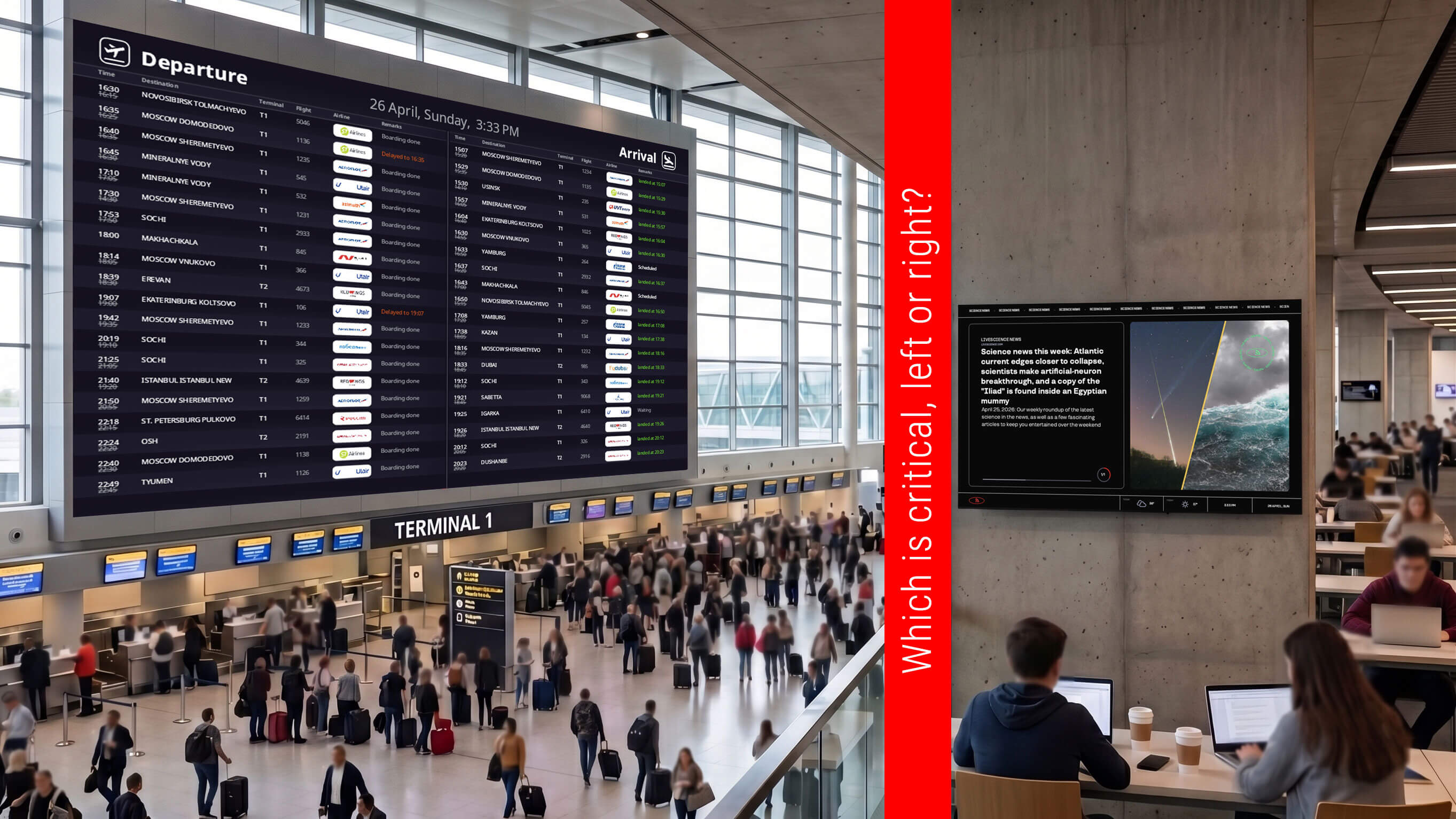
Two screens. Same panel. Same player. Same operating system. One displays the name of the hotel of the week. The other displays the gate change for a flight boarding in four minutes.
They are not the same system.
The difference is not the glass. It is not the player. It is not the CMS. It is what happens when the screen goes dark for two minutes. In one case: the hotel loses a click-through. In the other: five hundred passengers miss a departure, a regulator asks for logs, and an airline writes a cheque.
This article is about that difference — and why most of the regional digital signage industry still talks as if there isn't one.
The Word "Mission-Critical" Has Been Diluted
Every signage brochure now carries it. Mission-critical displays. Mission-critical menu boards. Mission-critical lobby screens. The phrase has been applied so broadly that it no longer tells a buyer anything.
This is not an accident. "Mission-critical" justifies higher prices, longer contracts, and thicker support plans. If a vendor can persuade a facilities director that a coffee-shop menu board is mission-critical, they can sell a support contract with SLA language copied from an airport procurement document.
The facilities director does not get mission-critical signage. They get commercial signage with a mission-critical invoice.
Real mission-critical media infrastructure is a narrow category. It is defined not by marketing language, but by three binding conditions — all of which must hold at the same time.
The Three-Part Definition
A media system is mission-critical media infrastructure if and only if all three of the following are true:
- 1
Failure causes irreversible loss.
Not a retry, not a discount, not a customer-service call. The loss is measured in lives, money, compliance status, or operational capacity — and it cannot be undone by showing the content five minutes later.
- 2
The audience makes a time-sensitive decision from the screen.
Not browses. Not considers. Decides — now — based on information the screen is displaying. Evacuation direction. Gate number. Queue position. Hazard status. Remove the screen and the decision is made wrong or not at all.
- 3
An external authority can measure the failure.
A regulator, an operator's SLA, a safety inspector, a contractually-bound counterparty. Someone other than your own marketing team has a standing right to audit uptime, demand logs, or impose a penalty.
Two out of three is not mission-critical. Two out of three is serious commercial signage — which deserves its own discipline, but not the same architecture, and not the same budget.
Where the Line Actually Is
Applied honestly, the three-part definition produces a short list on one side and a very long list on the other. This is what the industry doesn't want to publish, because the long list is where the easy margin lives.
- Airport flight information — FIDS, gate displays, baggage carousels. Regulated under ICAO, IATA, and national civil-aviation authorities.
- Hospital patient & evacuation — PIDS, ward displays, emergency wayfinding. Life-safety tied to JCI and local health-authority compliance.
- Stadium & venue egress — capacity, crowd-flow, alarm overlays. Egress and alarm duties sit with civil-defence codes and insurers; screens add visual guidance, but those codes do not require them.
- Public-safety evacuation — in the UAE, venues fall under Dubai Law No. (2) of 2026 on Public Safety, which asks for alarms, safety signage and a safety plan.
- Border and customs information — sovereign authority, operated under national security frameworks.
- Control-room dashboards — power, water, transport, process safety, SCADA context.
- Emergency broadcast overlays — alert overrides on otherwise-commercial networks, regulated by the operator of record.
- Financial trading-floor displays — where market data feeds into human decisions under regulatory audit.
- Mass-transit operations — train departure boards, metro platform displays, road-tunnel status.
- Retail menu boards — commercially important, not life-safety.
- Hotel lobby and guest-floor screens — brand, ambience, upsell.
- Corporate welcome and meeting-room displays — internal comms.
- Shopping-mall wayfinding — helpful, not load-bearing.
- Exhibition and event walls — campaign-bound, event-bound.
- Standard DOOH — advertising. An outage costs a refund, not a life.
- Cafeteria digital signage — regardless of how the specification reads.
- Corporate art and video walls — visual design, not decision support.
- In-office digital dashboards — KPI theatre, not production dependency.
"Not mission-critical" is not an insult. These systems deserve good engineering, good content, and good service. They just do not need — and should not pay for — the architecture the left column requires.
Notice what is not on the left column.
"Customer experience." "Brand consistency." "Digital transformation." These are real business concerns — but they are not mission-critical in the infrastructure sense. When a lobby screen is branded as mission-critical in a tender document, it usually means the specifier has confused "important" with "binding." The two words require different money.
The Five Properties of Real Mission-Critical Media Infrastructure
Once a system crosses the three-part threshold, five architectural properties become non-negotiable. Any one missing and the system drops back into the commercial category, regardless of what the invoice says.
Hardware Engineered for a 10-Year Lifecycle, Not a 3-Year Replacement Cycle
Mission-critical hardware must run 24/7 for a decade with documented failure rates under one percent. Consumer-grade and prosumer signage devices — smart TVs with an "enterprise" sticker, Android boxes, Pi-class players — operate with observed failure rates of 15–30 percent over three to five years. That delta is not a detail. It is the difference between a fleet you operate and a fleet you constantly rescue.
The SpinetiX HMP and iBX families post a 0.4% hardware failure rate over a ten-year window in production across thousands of deployed units. A fleet of one thousand players is expected to lose four units to hardware failure in ten years. A fleet of one thousand consumer-grade players is expected to lose one hundred and fifty to three hundred.
Lifecycle is not just about mean time between failures. It is about parts availability, firmware continuity, and the ability to replace a unit seven years after deployment with a compatible successor — without touching the rest of the fleet. SpinetiX has shipped four compatible hardware generations across eighteen years. Most consumer-grade signage platforms have shipped four generations across three.
A Purpose-Built Operating System, Not a Rehoused General-Purpose One
A player running a general-purpose operating system — Windows, stock Android, desktop Linux — inherits the entire CVE surface of that platform. When Log4j or Heartbleed or a Chrome zero-day lands, your signage fleet becomes a remediation project for a department that did not sign up to run remediation projects.
A purpose-built signage operating system — SpinetiX DSOS is the reference example — ships without a browser, without an app store, without a general-purpose runtime. There is no Java. There is no Flash. There is no user-installable software. The attack surface is what the vendor wrote, and nothing more. When Log4j happened, DSOS-based fleets had no exposure because the class of dependency was never on the device.
This is not hardening. Hardening is what you do to a general-purpose OS after the fact, by disabling services, adding firewalls, and patching monthly. Architectural minimalism is what you get when the OS was designed for one job and given no second job to do. For a mission-critical system, the second kind is the only kind worth specifying.
See the full threat taxonomy in the threat model for signage networks.
A Network Topology That Survives Its Own Backhaul
A mission-critical display must keep showing correct content when the internet disappears, when the cloud disappears, and when the building's own WAN disappears. The industry's most common sin is building a "cloud-native" signage system whose player is a thin client — and calling that architecture "modern."
It is modern in exactly one sense: it is modern to fail the first time the ISP has a bad day. In March 2026, a major hyperscaler's physical infrastructure was destroyed in a way no software-level redundancy compensated for. Fleets designed as thin clients went black across multiple industries that same morning. SpinetiX fleets did not — because the player stores every byte of content locally, treats the cloud as a convenience not a dependency, and accepts emergency content over the LAN via Elementi when the WAN is gone.
For mission-critical infrastructure, the minimum network properties are: (a) offline-first playback with full-quality local content, (b) a graceful-degradation discipline enforced at template level — no error banners, no broken widgets, no "connection lost" overlays visible to the audience, and (c) a local-network emergency channel for pushing override content without internet dependency. Anything less is a cloud product dressed up as infrastructure.
An Operational Model With Named Humans in the Region
Cloud-delivered support portals do not evacuate a building. Ticket queues staffed eight time zones away do not read Arabic signage at two in the morning. A mission-critical network needs Tier-1 responders who are in the region, speak the operator's language, and have a recorded sub-fifteen-minute response obligation — on contract, not on a website.
This is a commercial property as much as a technical one. Most regional signage integrators sell hardware and wish the customer good luck with the cloud dashboard. That is a perfectly valid business model — for commercial signage. It is an inadequate one for infrastructure whose failure ends up on a regulator's desk.
The test: name the human who will answer the phone at 02:00 on a Friday during a prayer-time transition at an airport gate area. If there is no name, there is no operational model.
A Single Accountability Chain, Mapped to Specific Regulations
The fastest way to identify a system sold as mission-critical but architected as commercial is to ask who is accountable when it fails. If the answer involves four vendors — one for the displays, one for the players, one for the CMS, one for support — the system has no accountable party. It has a blame surface.
Real mission-critical media infrastructure has a single named counterparty with an SLA explicitly mapped to the regulatory frameworks the operator is bound by: UAE PDPL, ISO 27001, ISO 22301 business continuity, JCI for healthcare, NIS2 where applicable, sector-specific civil-aviation and civil-defence codes. One vendor. One contract. One line in the compliance register.
For operators in the Middle East, the regional compliance surface is already substantial and growing: Dubai Law No. (2) of 2026 on Public Safety (alarms, safety signage and safety plans for venues; it names no screen requirement), UAE Cybersecurity Council requirements, Saudi National Cybersecurity Authority ECC controls, and sector-specific rules from the GCAA, MOH, and Dubai Civil Defence. A mission-critical signage contract names the frameworks it is binding itself to. A commercial one names features.
The Cost of Getting the Classification Wrong
Misclassification goes in two directions, and both are expensive. The industry almost never talks about the first direction, because the first direction is where its revenue comes from.
Over-classifying — Paying Infrastructure Prices for a Menu Board
A fast-casual restaurant chain specifies mission-critical architecture for its drive-through menu boards. Redundant players. Dual-path networks. 24/7 enterprise support. ISO 27001 cloud with data-residency clauses. Hardware with ten-year lifecycle.
None of this is wrong. But none of it is earned by the use case. The total cost of ownership is three to ten times what a well-specified commercial deployment would be — with no corresponding recovery. The chain is paying for uptime guarantees that apply to nothing on their menu, compliance mappings that cover no actual regulatory obligation, and support tiers for failures that would be inconvenient rather than dangerous.
The vendor is delighted. The margin is mission-critical even if the menu board isn't.
Under-classifying — Running Infrastructure on Commercial Gear
A public hospital specifies the signage network under the facilities-management tender. The scope is written for wayfinding. The budget is written for wayfinding. Three years later, the same displays are doing bed-status in the emergency department and evacuation-route overlays tied to the fire-alarm system. The scope grew; the architecture did not.
When an incident happens — a corridor screen goes black during an evacuation, a patient-flow dashboard shows stale data during a triage surge — the failure is investigated not under facilities management but under clinical governance. The vendor's best-effort SLA, which was entirely reasonable for wayfinding, is not entirely reasonable for life-safety. The investigation now includes a timeline of the last firmware patch that did not happen.
This is the pattern that regulators in the region are beginning to pre-empt. Dubai Law No. (2) of 2026 attaches fines of AED 500 to 1,000,000 (up to AED 2,000,000 only for repeat violations) to venues that fail their public-safety duties. It names no display technology, but the premise carries over: an operator who chooses a screen for an evacuation role is relying on it in that role, whatever scope it was ordered under.
Commercial signage used in a mission-critical role is not a product decision. It is a latent liability that activates the first time the system is asked to do what the sign-off document never said it would.
A Ten-Question Decision Framework
Score your deployment honestly. One point per yes. The threshold is not ambiguous.
- 01If every screen in the network is dark for thirty minutes, does someone — not you — write a formal incident report?
- 02Does a regulator, operator SLA, or contracted counterparty have a standing right to audit the uptime of this network?
- 03Is there at least one moment in a normal week when a human being makes a safety-relevant, time-sensitive decision from the content on a screen?
- 04Does the network display, or is it expected to display, emergency or evacuation content triggered by an external life-safety system?
- 05Would a two-hour outage, tomorrow, generate external inquiries from anyone other than your own team?
- 06Is the network part of — or does it interact with — a fire-alarm system, SCADA network, hospital information system, air-traffic interface, or financial market-data feed?
- 07Does your organization carry specific regulatory obligations under UAE PDPL, ISO 27001, JCI, civil-aviation rules, civil-defence codes, or sector-specific frameworks that could reasonably cite this network in a finding?
- 08Is the content on the screens ever time-of-day, gate-change, schedule-change, status, queue, occupancy, or hazard information that an audience depends on being current?
- 09Is the deployment expected to run on the same core hardware, with compatible successors, for eight years or more?
- 10If the cloud component of the system were permanently destroyed overnight, is there an internal stakeholder who would classify "displays continued to show correct content" as a non-negotiable requirement?
Commercial signage. Buy accordingly. Do not pay an infrastructure premium.
Serious commercial. Needs professional architecture and real support — but not the full mission-critical stack.
Mission-critical media infrastructure. All five architectural properties are required. Do not compromise on any one.
What Mission-Critical Media Infrastructure Actually Looks Like
If a specification crosses the threshold, the components that meet it already exist and have been deployed across the region for close to two decades. The pattern is concrete, not aspirational.
The player is industrial hardware with a documented failure rate under one percent over ten years — in the SpinetiX line, the HMP and iBX families. The operating system is SpinetiX DSOS: purpose-built, read-only filesystem, signed firmware, no app ecosystem, no browser, no user-installable runtime. The management layer is architecturally offline-first: cloud for convenience, local storage for correctness, Elementi over LAN for emergencies.
The network posture is zero-trust by design: signed identity, mutual TLS, no open ports, no enterprise data transiting the signage cloud. The full five-layer security architecture maps cleanly to ISO 27001, UAE PDPL, and sector-specific controls without post-hoc additions.
The operational model is Tier-1 response in-region with a sub-fifteen-minute SLA, named engineers rather than a ticketing queue, and an accountability chain that begins and ends with one counterparty. Media La Vista has operated this model as the regional Master Distributor for SpinetiX since 2007 — specifically for the deployments where the cost of being wrong is measured in more than a refund.
Where this matters most concretely in the region today: the Dubai Public Safety Law (No. 2 of 2026) and where screens fit. The law does not mandate screens, but where an operator uses them for evacuation guidance, the infrastructure properties above are what make them dependable.
The Buyer's Job
The first question in a signage tender is not "which platform." The first question is: is this system mission-critical, or not? Answer that honestly — and both the specification and the budget become obvious.
Answer it wrong in the direction of over-classification and the vendor is happy. Answer it wrong in the direction of under-classification and the regulator is.
The point of infrastructure is not that it never fails. The point of infrastructure is that when it fails, the failure is bounded, accountable, and recoverable — and that someone with a name, a contract, and a pager is obliged to explain why. If the system you are specifying cannot produce that person, the screens on the wall are not infrastructure. They are décor with a DHCP lease.
Frequently Asked
What is mission-critical media infrastructure? +
Is my digital signage mission-critical? +
What is the difference between commercial and mission-critical digital signage? +
What architectural properties does mission-critical media infrastructure require? +
What does it cost to misclassify signage as mission-critical — or fail to classify it at all? +
Is SpinetiX mission-critical infrastructure? +
Next step
Score your deployment. Then talk to an engineer.
If you scored 7–10 on the framework above, the specification you have in hand is probably under-written for the role the system will actually play. We do a free, no-sales architecture review for deployments in that band — one call, a line-by-line read of the scope, a written note of what would need to change to meet the five properties.
Continue Reading
Digital Signage Is No Longer a Purchase. It's an Investment.
Cybersecurity Isn't a Feature. It's a 20-Year Discipline.
SpinetiX Security Architecture — Five Defense Layers
When the Cloud Burns: Zero-Trust Digital Signage
Dubai's Public Safety Law: What It Asks of Venues, and Where Screens Fit
Threat Model for Signage Networks
Or return to the Knowledge Center for the full library of architecture, security, and operations guidance.