/ Digital Signage — Saudi Arabia /
Digital Signage in Saudi Arabia — On-Premises Infrastructure for Vision 2030
Digital signage in Saudi Arabia is enterprise visual infrastructure designed for NCA ECC and SAMA Cyber Security Framework compliance, delivering on-premises content automation across Vision 2030 megaprojects, Hajj and Umrah crowd-flow at the Two Holy Mosques, SAR-denominated banking branches, and Aramco-class energy operations from Riyadh to Tabuk's NEOM region.
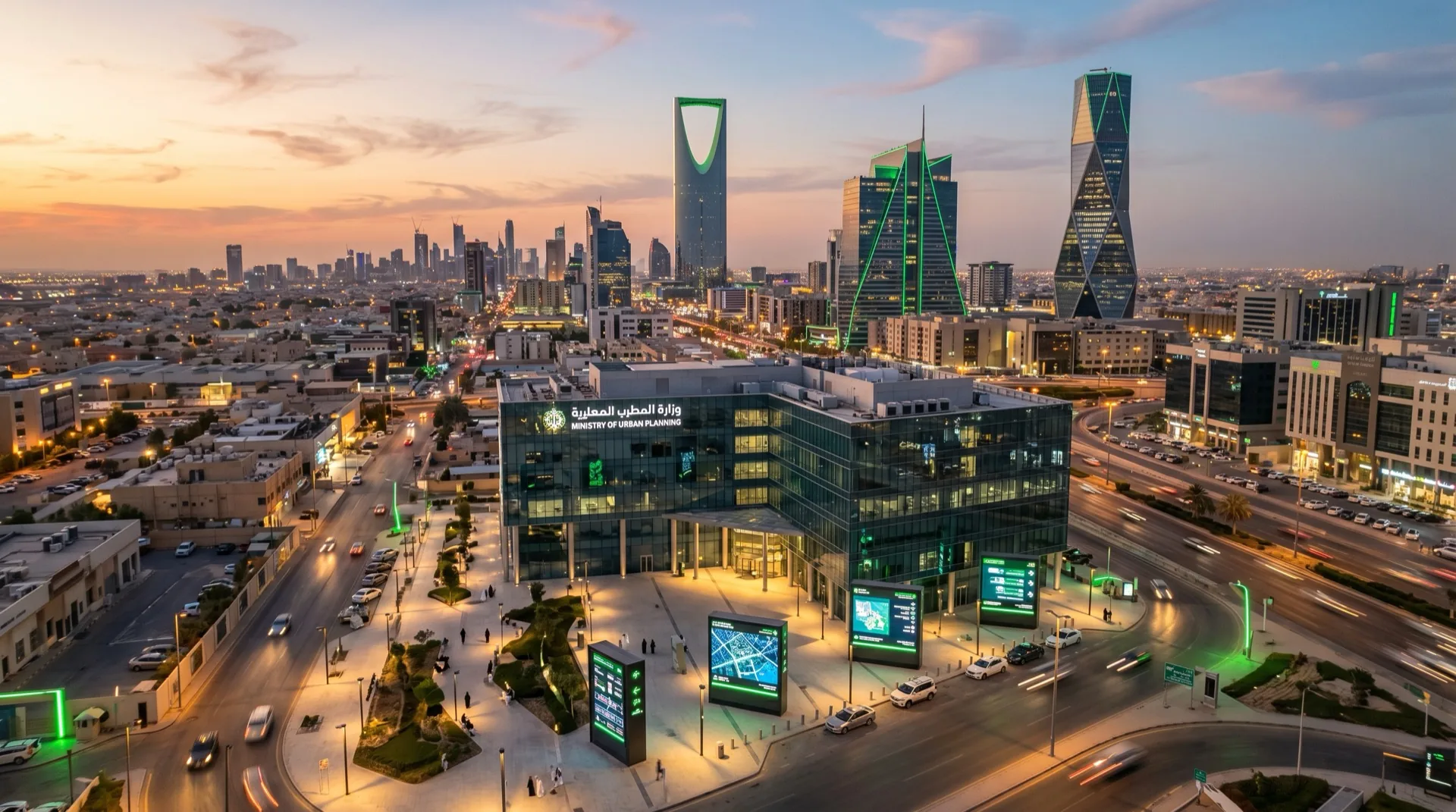
Saudi Arabia hosts the Two Holy Mosques in Mecca and Medina — the most attended public spaces in human history, with up to 4 million pilgrims during a single Hajj season — and is in the middle of a $1 trillion+ private-sector reinvention through Vision 2030, the largest national economic transformation of the modern era. Digital infrastructure deployed inside the Kingdom must meet that scale on day one, and last for the next decade.
Why on-premises is the default in the Kingdom
Three regulatory layers converge in Saudi Arabia and push digital media infrastructure decisively toward on-premises architectures:
- NCA Essential Cybersecurity Controls (ECC) — issued by the National Cybersecurity Authority — define minimum controls for critical infrastructure operators, including segmented networks, signed firmware, and audit logging. Generic Android-based signage cannot meet ECC-1 controls without heavy custom hardening; SpinetiX's purpose-built DSOS reaches them out of the box.
- SAMA Cyber Security Framework — for SAMA-regulated banks, money-changers, and finance companies — requires that visual systems on the branch network do not introduce unmanaged cloud egress paths. On-premises Elementi, with no outbound telemetry, satisfies this without compensating controls.
- Personal Data Protection Law (PDPL) — KSA's PDPL came into force in 2024 and treats data residency as a default obligation for personal data. Wayfinding and queue-management systems that capture or display personal information must keep that data inside the Kingdom unless an explicit cross-border transfer permit is in place.
These three frameworks are why Aramco-class energy operations, Royal Court installations, and Two-Holy-Mosques deployments specify most secure, on-premises media infrastructure as the baseline — and why Media La Vista distributes a platform purpose-built for it, not retrofitted from consumer hardware.
Sectors served in the Kingdom
Aramco-grade operations
The Saudi energy market is led by operators with hard on-premises mandates — refineries, gas plants, control rooms. SpinetiX iBX440 players are designed for the same standard: signed firmware, no consumer attack surface, deterministic playback for safety-critical broadcast.
Mecca & Medina mosque infrastructure
Multi-zone Arabic + English wayfinding, real-time crowd-density routing in the Mashair area, and prayer-time integration via the Umm Al-Qura method. Players continue local playback when peak-density network saturation makes cloud unreachable.
SAMA-regulated branches
Branch displays for SAMA-regulated banks need to live inside the bank's segmented network — no outbound cloud, signed updates, full audit. Riyad Bank, Al Rajhi-class deployments use on-prem media architectures by default; SpinetiX is built to that bar.
NEOM · Diriyah · Red Sea · Qiddiya
The PIF-backed megaprojects need media infrastructure with a 10+ year hardware lifespan, multi-zone content automation, and the ability to scale from a single visitor centre to a whole new city. Designed-for-purpose hardware, not retrofitted IT.
Royal Court · Ministries · KKIA / KAIA / KFIA airports
Air-gapped wayfinding at King Khalid Intl, King Abdulaziz Intl, and King Fahd Intl. Ministry of Hajj operations centres. Royal Court briefing displays. All on infrastructure that meets NCA ECC controls and operates with no cloud dependency. See how digital signage for government is specified on-premises.
MoH facilities · KFSHRC · KAUH
Wayfinding, queue management, prayer-time-aware scheduling. Hospital displays must run as life-safety adjacent — never blank, never compromised, never dependent on a cloud service that can be cut off mid-incident.
All entity references above describe the Saudi market context and the standards Media La Vista's platform meets. They do not imply existing project engagements with the named organisations.
Compliance & data sovereignty in detail
| Framework | What it requires | How SpinetiX maps to it |
|---|---|---|
| NCA ECC | Signed firmware, audit, network segmentation, no unmanaged cloud egress | DSOS signed images, syslog/SNMP audit, deterministic per-player config, on-prem Elementi |
| SAMA Cyber Sec FW | Banking-network containment for branch infrastructure | Players sit on bank VLAN; no outbound except where bank explicitly allows; encrypted media at rest |
| PDPL (KSA) | Personal-data residency inside the Kingdom unless explicit transfer permit | No telemetry to foreign clouds; on-prem hub keeps captured/displayed data inside borders |
| CITC technical regs | Type approval for ICT equipment imported into KSA | SpinetiX hardware certified through CITC-recognized conformity routes via local partners |
| ZATCA e-invoicing | Phase 2 e-invoicing for B2B transactions | Local partners (Professional Signs, Hilal Computer) handle compliant invoicing in SAR |
| SABER product cert | Pre-import conformity for regulated products | SpinetiX players certified through the SABER platform with our partners as record-importers |
Logistics & supply chain into the Kingdom
We know the routes. SpinetiX hardware ships from Switzerland through MLV's Dubai master-distribution warehouse in Dubai Silicon Oasis, then crosses into the Kingdom via established freight lanes through King Fahd Causeway (via Bahrain) or direct air freight to King Khalid International. Local partners — Professional Signs in Riyadh and Hilal Computer in Dammam — are the registered importers of record, handle SABER conformity, ZATCA e-invoicing in SAR, and last-mile staging at the customer site.
Typical delivery windows: 5–10 working days from MLV stock in Dubai to a Riyadh or Jeddah project site, including SABER pre-clearance. NEOM-region (Tabuk) deployments add 2–3 days for last-mile. Customer-of-record options are flexible — local partner-led for projects requiring 100% Saudization of the supply chain, or co-signed with MLV for multi-country GCC programmes.
Local support in Riyadh, Jeddah, Dammam
Professional Signs LLC
King Abdullah Street, Riyadh. First-line presales, on-site commissioning, and Tier-1 support across the central region — Riyadh, Qassim, Hail, AlUla.
Languages: Arabic + English. Tier 2/3 escalation routes to MLV engineering in Dubai with a 10-minute response SLA for Partner Club projects.
Hilal Computer & Technical for Trade Co.
Hugayath Modern Center, Dammam. First-line presales and on-site support for the Eastern Province — Dammam, Khobar, Jubail, Ras Tanura.
Languages: Arabic + English. Special expertise in industrial and energy-sector deployments where SAMA + NCA controls overlap.
Coverage for Jeddah, Mecca, Medina, and the NEOM/Tabuk corridor is delivered jointly by both partners and Media La Vista's Dubai engineering team, depending on project scope. For Hajj-period deployments at Mashair and the Two Holy Mosques, MLV stages dedicated on-site engineers during the season — you do not depend on remote support during the most operationally critical 10 days of the year.
10-year lifecycle math, in SAR
Total cost of ownership over a Vision 2030 timeline is dominated by the replacement curve, not the unit price. A typical mid-tier Android signage player retails around 2,000–3,000 SAR but expects 2-3 year refresh. A SpinetiX iBX440 sits higher on the unit price, but is engineered for 10+ years of continuous operation — commercial-grade build with a segregated external-fan airflow design rated for 24/7 duty, signed firmware updates published for the full lifecycle.
Run that across a 100-screen Riyadh metro corridor or a 500-screen NEOM visitor-experience programme: by year 6, the commodity-hardware project has paid for the same 100 screens twice over; by year 10, three times. SpinetiX has been refreshed once, in firmware, with the same physical players running. That is the math behind the Kingdom's preference for built-to-last visual infrastructure.
Automation cases unique to Saudi Arabia
- →Umm Al-Qura prayer-time automation — Elementi feeds the Kingdom's official Umm Al-Qura calculation method directly into content schedules. Five daily prayers automatically pause non-religious content; mosque-adjacent retail respects salah windows without operator intervention.
- →Hijri-calendar scheduling — Ramadan, Eid, Hajj season, and National Day (23 September) all fire on Hijri or Gregorian dates as needed; multi-year campaigns roll automatically without re-authoring.
- →Hajj crowd-density routing — integration with sensor and CCTV vendors lets Mashair-area screens dynamically reroute pilgrim flow when a sector saturates, with content authored once and adapted at runtime by the player itself.
- →Aramco-class control-room broadcast — frame-accurate playback of safety alerts, KPI overlays, and emergency-evacuation messages, with deterministic synchronization across paired displays.
- →SAMA-aligned banking branch automation — exchange rates, queue tickets, regulatory disclosures pulled from the bank's own systems via 250+ Elementi widget-constructors, all on segmented branch networks with no outbound cloud.
Become a partner in the Kingdom
Vision 2030 is a 12-year programme. The integrators who build it will be the integrators who keep it running for the decade after. Media La Vista's Partner Club is open to AV and IT integrators in Saudi Arabia who want presales engineering in Arabic, qualified-lead routing from MLV's Tier-1 enquiries, co-branded RFP responses to PIF-backed projects, and subsidised certification through ME Academy for their staff.
Two partners cover the Kingdom today; the ecosystem has room for many more — particularly in Jeddah, Mecca, Medina, AlUla, NEOM/Tabuk, and the Northern Borders region. If your firm is delivering visual infrastructure to Royal Court, ministry, banking, or megaproject clients and wants a built-to-last platform behind the work, the Partner Club is the door.
Frequently asked questions
Where can I buy SpinetiX digital signage in Saudi Arabia? ▾
How long does it take to get digital signage players delivered to Riyadh or Jeddah? ▾
Does digital signage hardware need SABER or CITC certification to be imported into Saudi Arabia? ▾
Can digital signage display Arabic correctly, right-to-left, alongside English? ▾
Can screens pause automatically during prayer times in Saudi Arabia? ▾
Does Saudi Arabia's PDPL require digital signage data to stay inside the Kingdom? ▾
Can digital signage run fully on-premises for SAMA-regulated banks in Saudi Arabia? ▾
How do you run digital signage for Hajj and Umrah crowds in Mecca and Medina? ▾
What kind of digital signage do Vision 2030 megaprojects like NEOM and Diriyah need? ▾
Are SpinetiX players worth the higher unit price in Saudi Arabia? ▾
Related reading
Mission-Critical Media Infrastructure — What It Actually Means
The architecture standard NCA ECC and SAMA require, applied to digital signage.
Zero-Trust Digital Signage
When the cloud burns, your signage keeps running. Offline-first architecture explained.
Cloud vs On-Premises Architecture
The decision framework for SAMA, NCA, and PDPL-regulated environments.
Security by Design for Signage
How DSOS, signed firmware, and segmented networks line up against ECC controls.
Build for Vision 2030 with infrastructure that lasts the decade
Talk to our engineering team in Dubai or our partners in Riyadh and Dammam. We move from architecture to deployed players faster than RFP cycles usually allow.