

Prayer time integration for digital signage is one of the most technically demanding features in the Middle East. Five daily prayers tied to the sun's position. Seven major calculation methods producing different results. Every country's religious authority publishing its own schedule that diverges from pure math by 1–5 minutes. Arabic RTL rendering. Hijri calendar. Audio announcements. Content switching during prayer. No single algorithm matches all official schedules. SpinetiX solves this with a 3-layer data architecture: government source → API fallback → local mathematical calculation — fully automated, offline-capable, and natively bilingual.
Why It's More Complex Than You Think
"Just show prayer times on the screen." What sounds like a 10-minute task is actually a deep integration problem that spans astronomy, theology, politics, and software engineering.
Three of the five daily prayers (Dhuhr, Asr, Maghrib) are tied to deterministic solar events — noon, shadow length, sunset. Two (Fajr and Isha) are not. Fajr depends on when "true dawn" appears — a visual phenomenon affected by season, latitude, altitude, atmospheric dust, humidity, and light pollution. The solar depression angle at which dawn becomes visible varies between 12° and 20° depending on conditions. That's not a rounding error. At Dubai's latitude (25°), a 1° Fajr angle shift moves the prayer time by 4–5 minutes. At Almaty's latitude (43°), the same 1° shift produces a 5–7 minute swing.
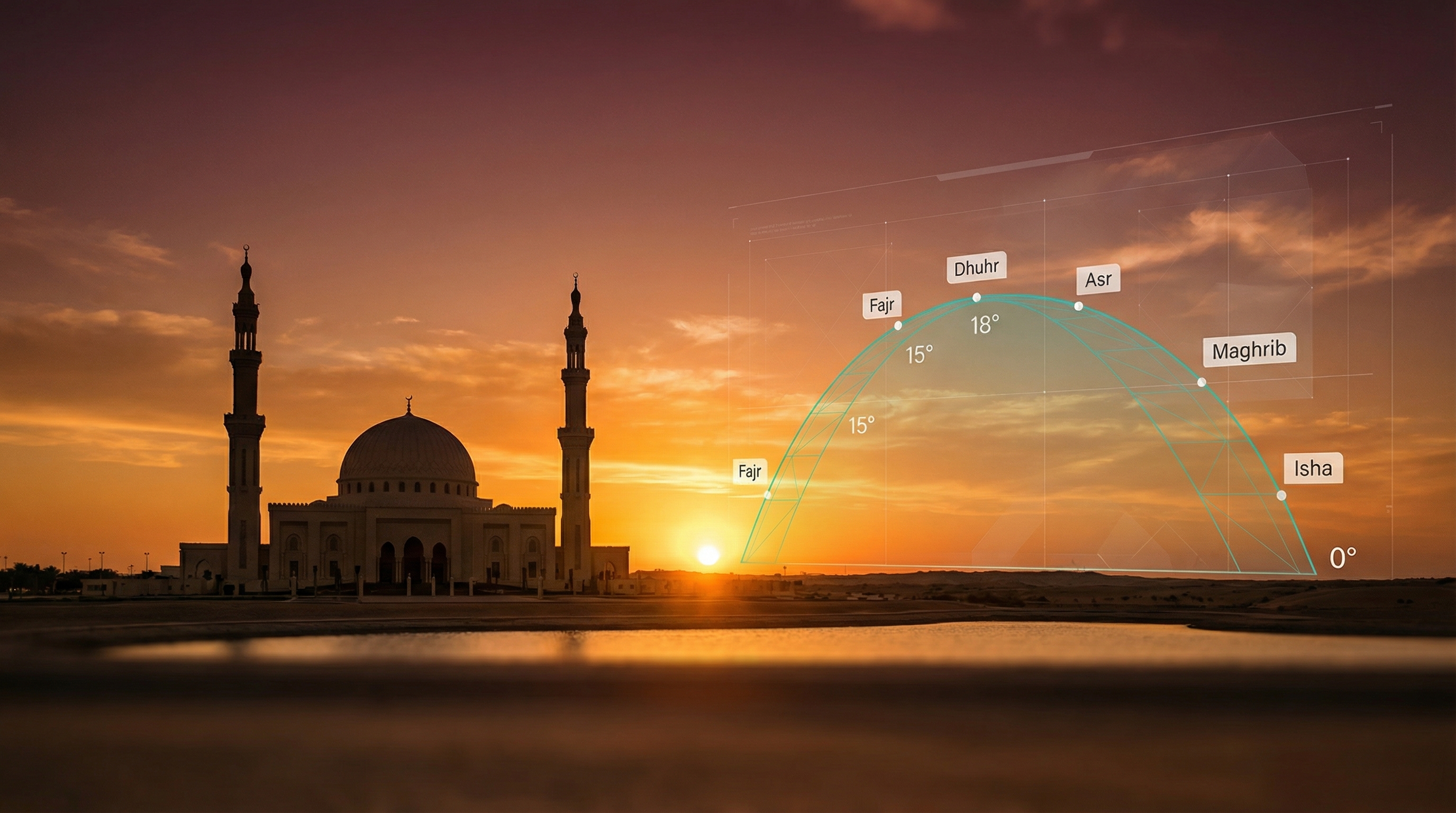
Now multiply this by the fact that seven major calculation methods exist — each choosing different angles for Fajr and Isha. And then every government religious authority adds its own corrections, safety margins, and seasonal adjustments on top.
The Seven Major Calculation Methods
| # | Authority | Fajr Angle | Isha Rule | Typical Region |
|---|---|---|---|---|
| 1 | Muslim World League (MWL) | 18° | 17° | Europe, Far East |
| 2 | ISNA | 15° | 15° | USA, Canada |
| 3 | Egyptian General Authority | 19.5° | 17.5° | ME, North Africa |
| 4 | Umm Al-Qura, Makkah | 18.5° | 90 min after Maghrib | Saudi Arabia |
| 5 | Karachi University | 18° | 18° | Pakistan, South Asia |
| 6 | Tehran (Geophysics) | 17.7° | 14° + Maghrib at 4.5° | Iran, Shia communities |
| 7 | Turkiye Diyanet | 18° | 17° + 9 min offset | Turkiye |
The spread between ISNA (15°) and the Egyptian method (19.5°) produces a Fajr difference of 18–22 minutes at Dubai's latitude — and up to 30+ minutes at Almaty. Choosing the wrong method is not a minor error. It's a theological violation on a public screen.
Three Layers of Prayer Time Data
A production system that must show correct prayer times on screens in airports, malls, theme parks, stadiums, and public venues needs a layered data architecture — not a single calculation.
| Layer | Source | Accuracy | Availability | Use Case |
|---|---|---|---|---|
| 1. Official | Government authority API or website parse | Exact (authoritative) | Depends on API stability | Primary source — always preferred |
| 2. Aladhan API | aladhan.com with country-specific method + tune offsets | ±1–3 min vs. official | High (public API) | Fallback when official source is down |
| 3. SpinetiX Widget | Built-in math: geo coords + method + per-prayer offsets | Method-dependent | Always (local, offline) | Ultimate fallback — no internet needed |
The validation layer compares Layer 1 vs. Layer 2 continuously. If the delta exceeds 5 minutes, it triggers an alert — indicating the official source has changed parameters or the API is returning stale data. This is the architecture Media La Vista deploys for data-driven signage systems across the Middle East.
Country-by-Country: Real Data Sources
Every country has its own religious authority, its own method, and its own quirks. Here is what a real-world deployment requires:
UAE (Dubai) — IACAD / Awqaf
The Islamic Affairs and Charitable Activities Department (IACAD) in Dubai and the federal Awqaf authority publish official times. The Dulook DXB app is the primary channel. No documented public API exists — IACAD's open data endpoint at iacad.gov.ae previously returned prayer time data but now returns 404. The Awqaf website provides current times but requires parsing. SpinetiX players consume REST APIs and parse structured web data natively.
Method: Dubai/Gulf Region — 18.2° for both Fajr and Isha (custom, not matching any of the 7 standard methods). Starting January 2, 2026, the UAE implemented unified Friday prayer at 12:45 PM across all emirates — a purely institutional decision, not astronomical.
Qatar — Awqaf Qatar
The Ministry of Endowments and Islamic Affairs publishes Qatar's official schedule. Aladhan's method 10 (labeled "Qatar") uses Fajr at 18° with Isha at 90 minutes after Maghrib. Close to official times but not exact. Qatar and Saudi Arabia follow different calendars for Ramadan start/end based on actual moon sighting vs. calculation — introducing timing variability during the fasting month.
Saudi Arabia — Umm Al-Qura
The most standardized method: Fajr at 18.5°, Isha fixed at 90 minutes after Maghrib (120 minutes during Ramadan). The fixed duration for Isha makes this fundamentally different from all angle-based methods. Aladhan method 4 is reliable for Saudi Arabia.
Kazakhstan — Muftyat
The Spiritual Administration of Muslims of Kazakhstan (DUMK) publishes a clean GPS-based API:
api.muftyat.kz/prayer-times/{year}/{lat}/{lng}. Returns full-year JSON, no
authentication required. The cleanest data source found in research. The Muftyat applies a
consistent 3-minute Maghrib offset (safety margin) and uses custom Fajr/Isha angles in
the 18–19° range — not matching any standard Aladhan method exactly.
Beyond the Clock: What Happens During Prayer
Showing the next prayer time is only the beginning. A properly integrated system turns the entire screen into a contextual experience around the prayer cycle. This is where SpinetiX's content automation capabilities become essential.
Adhan Announcements
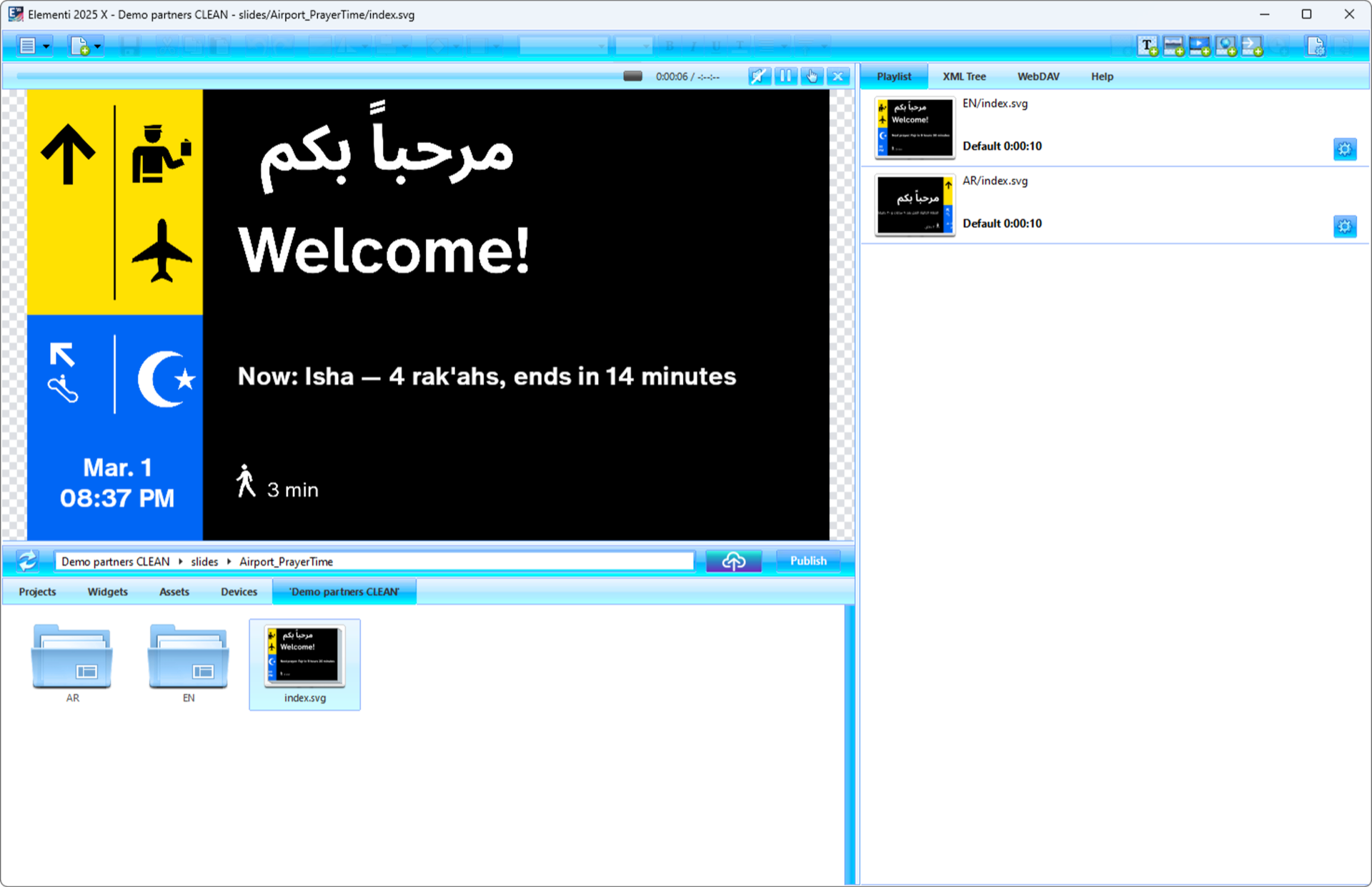
When prayer time arrives, screens can trigger a full-screen or popup notification with muezzin audio. This can be a short overlay banner ("Now: Isha — 4 rak'ahs, ends in 14 minutes") or a full takeover with the adhan call. SpinetiX players support audio output natively — connect to the venue's PA system for synchronized visual + audio announcements across airports, malls, stadiums, and theme parks.
Content Switching During Prayer
During prayer time, content can automatically switch to:
- Live stream from Makkah — Kaaba video feed
- Quran recitation — ayat display with Arabic calligraphy and translation
- Prayer countdown — time remaining until prayer ends
- Respectful pause — branded or neutral screen during prayer duration
After prayer concludes, regular signage content (wayfinding, promotions, information boards) resumes automatically. This behavior is scheduled based on the prayer time data feed — no manual intervention.
Managed Mosque Mode
In mosques, screens inside the prayer hall can serve as guided prayer assistants. During each prayer, the display can show step-by-step guidance: which surah to recite, how to move between positions (standing, bowing, prostrating), which rak'ah you're on, and what to think about during each movement.
A designated helper can trigger specific scenarios from a tablet using SpinetiX RPC controls — or sequences can run fully automatically based on the prayer schedule. This approach is particularly effective for attracting younger Muslims to the prayer experience: showing what to do means caring about newcomers, which builds loyalty and engagement.
Where Prayer Time Screens Are Deployed
| Venue | Screen Location | Prayer Display | During-Prayer Behavior |
|---|---|---|---|
| Airport | Departure gates, prayer rooms, arrivals | Next prayer + countdown | Prayer room screens switch to Quran; gate screens show discreet banner |
| Shopping mall | Entrance, food court, corridors | All 5 prayers + next highlight | Audio announcement via PA; content dims or switches to respectful display |
| Stadium / arena | Concourse, VIP lounges, gates | Next prayer overlay | Reduced brightness; prayer room wayfinding activated |
| Theme park | Entrance, rest areas, info points | Prayer times + nearest prayer room | Wayfinding to prayer facilities intensified |
| Corporate office | Lobby, floors, meeting rooms | Sidebar widget | Meeting room screens show "Prayer time — please pause" |
| Mosque | Entrance, prayer hall, courtyard, minaret | Full schedule + Iqamah | Guided prayer mode; live Makkah; Quran ayats |
| Hotel lobby | Reception, elevator zone | Next prayer + Qibla direction | Lobby screens show Quran verses or Islamic art |
Why SpinetiX Gets This Right
Most signage platforms can display a clock. Few can handle the full complexity of Middle Eastern prayer time integration. SpinetiX addresses every layer of the problem — from astronomical math to government data parsing to Arabic typography.
Native RTL and Arabic Support
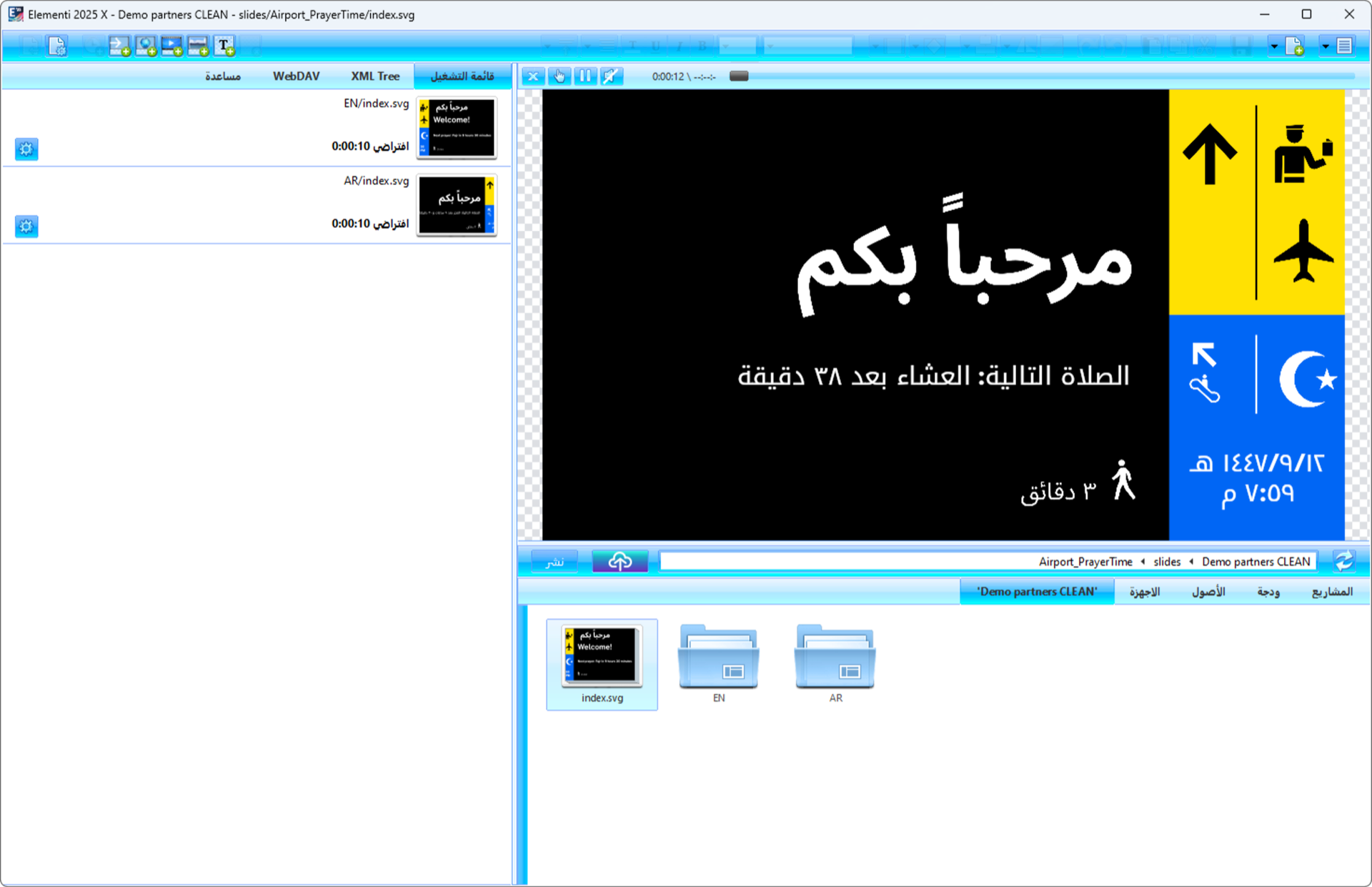
SpinetiX renders Arabic script natively with proper right-to-left layout. Custom fonts? Upload any .ttf or .otf directly to the player. No transliteration hacks, no broken ligatures, no reversed text. The jSignage framework handles bidirectional text mixing (Arabic + English on the same screen) correctly. The Elementi authoring environment can be fully switched to Arabic interface.
Arya Hybrid Cloud Automation
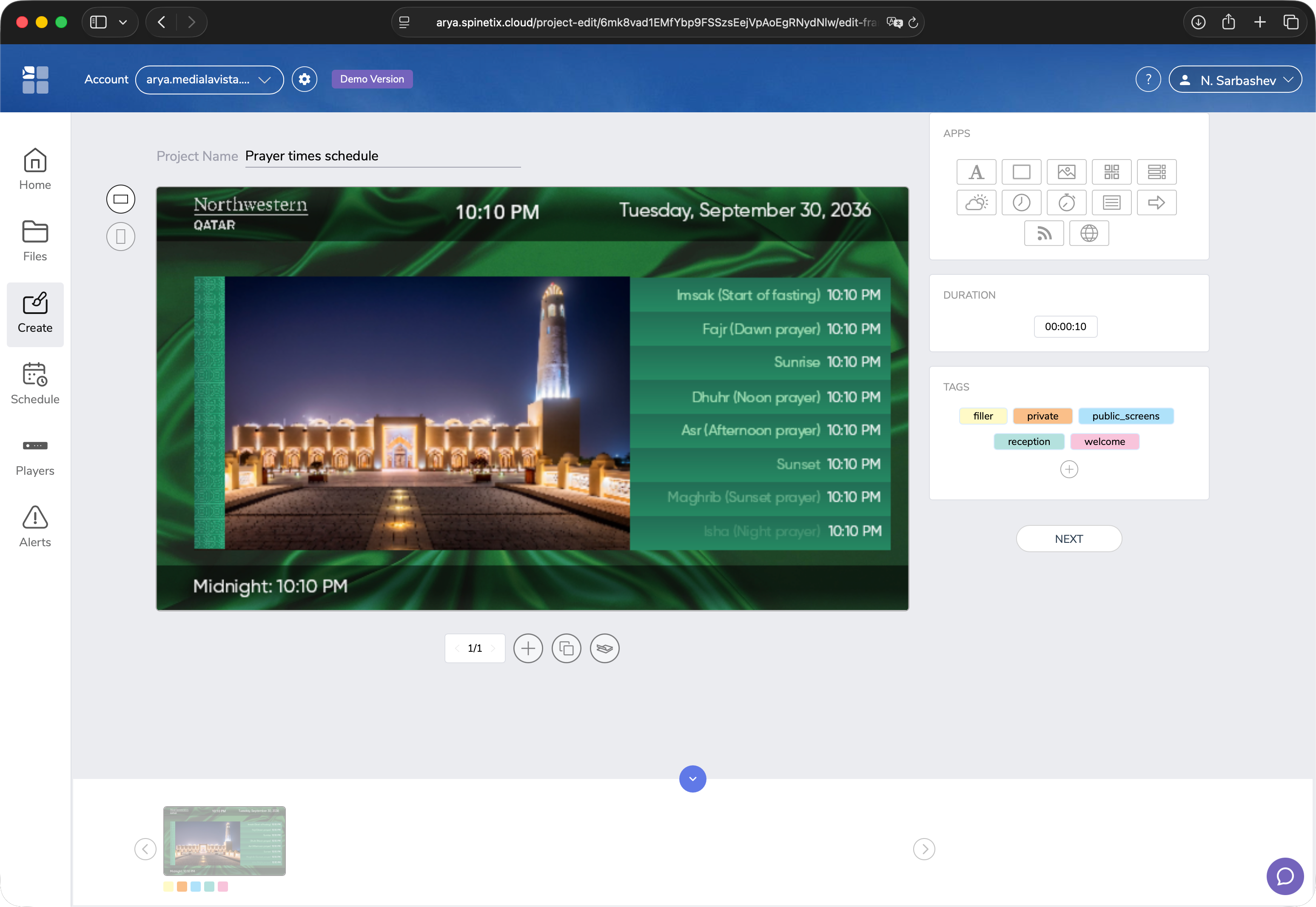
For deployments using the Arya cloud CMS, the exact same power is available through our hybrid architecture. You create the data-driven bilingual template once in Elementi, upload it to Arya, and from there, it can be auto-published to thousands of screens worldwide using simple tags. This gives you the best of both worlds: deep technical integration for pulling local prayer times and the simplicity of cloud distribution for your operations teams.
As detailed in our zero-trust digital signage architecture guide, this is exactly why Arya is a true hybrid solution: live data and local credentials never cross the boundary between your facility and the cloud. Only the visual templates and media assets are managed centrally. No passwords, no sensitive data, and no internal network exposure to the internet—never. The players pull the layout from Arya, but the prayer times data (whether from a local API or built-in calculation) is acquired and rendered entirely inside your secure network.
Built-in Prayer Time Widget
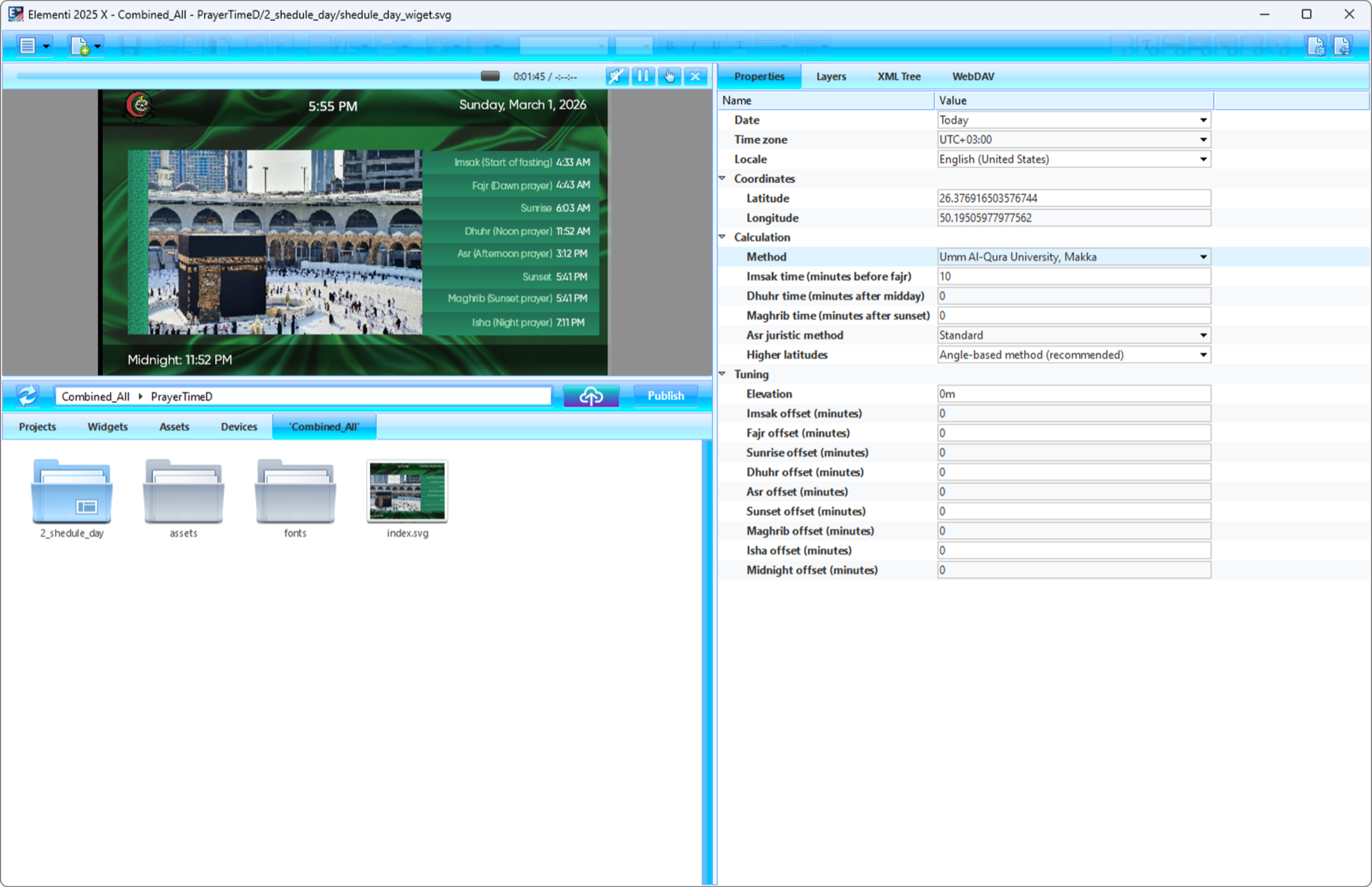
The SpinetiX prayer time widget calculates all prayers using GPS coordinates, selectable calculation methods (Umm Al-Qura, MWL, Egyptian, ISNA, Dubai, and more), and per-prayer minute offsets for fine-tuning. It runs locally on the player hardware — no API call, no internet, no external dependency. This is the ultimate fallback that ensures prayer times always display, even during a complete network outage. An offline-first architecture for the most critical content on Middle Eastern screens.
API Data Feed Consumption
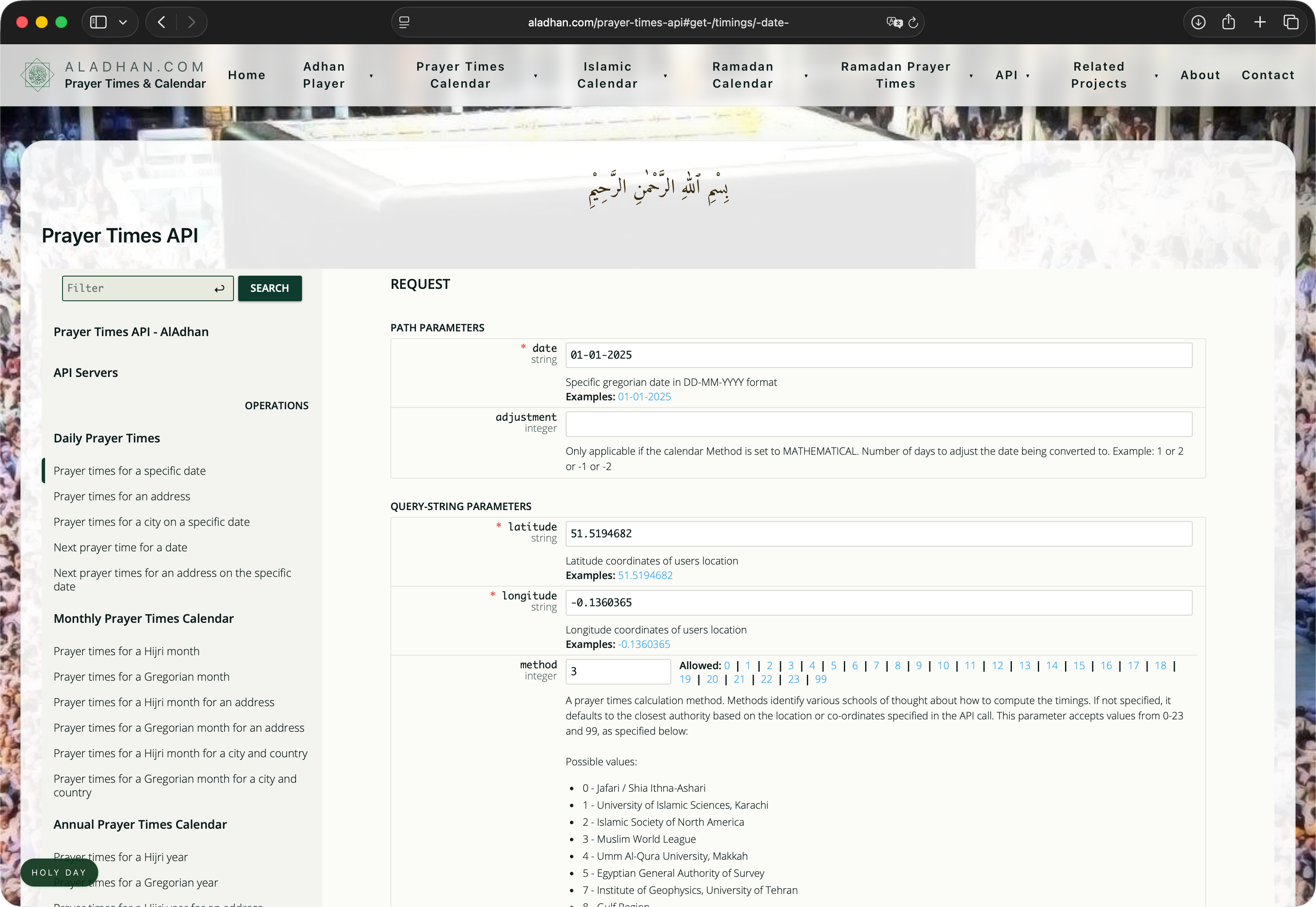
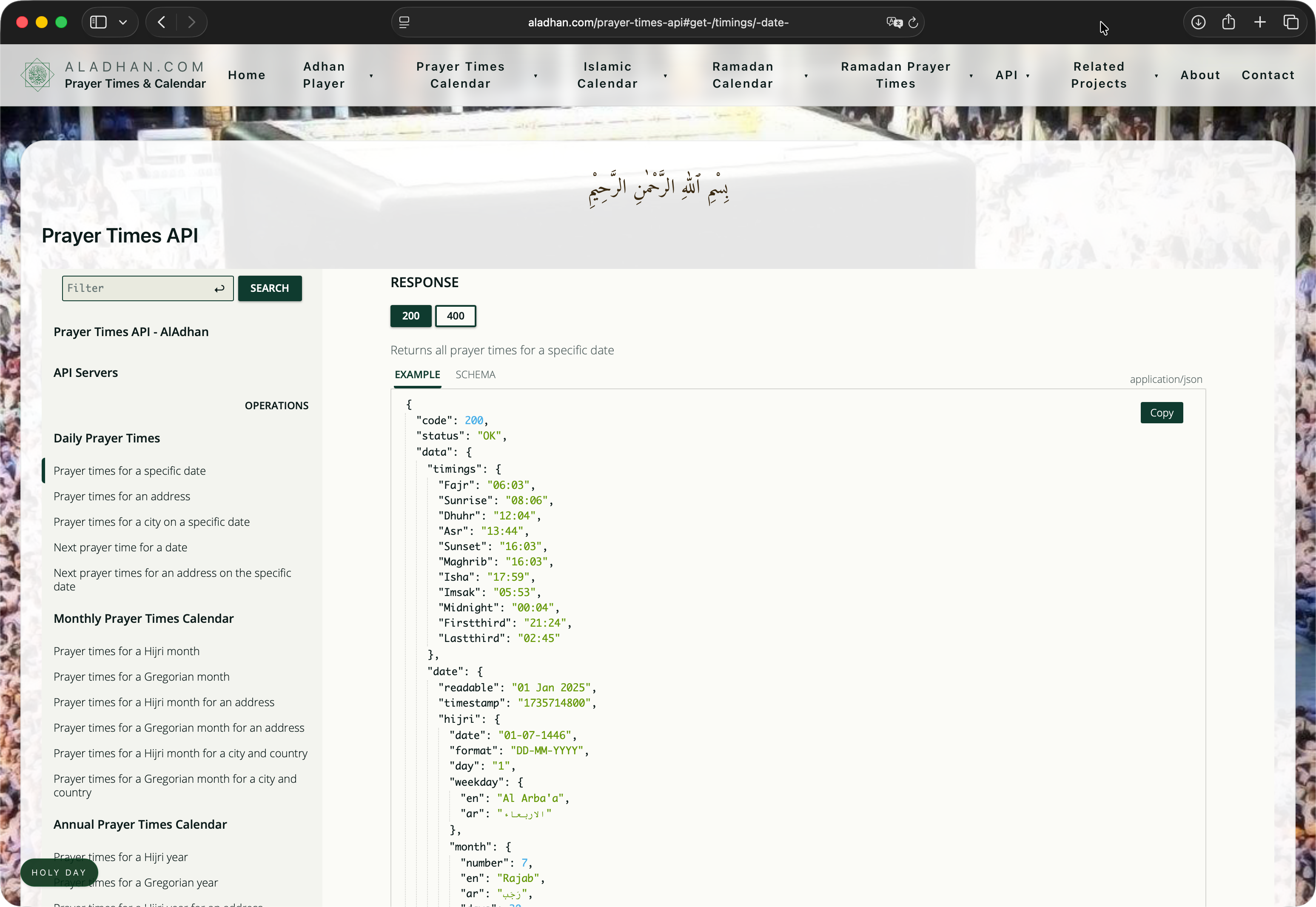
For primary-source accuracy, SpinetiX players fetch prayer times from official APIs using data feed widgets. JSON, XML, and REST endpoints are consumed natively. For sources without a clean API (like UAE's Awqaf website), SpinetiX can parse structured web pages — the same approach Media La Vista uses for weather and news feeds across the region.
Architecture for Multi-Country Deployments
Regional organizations operating screens across multiple countries (hotel chains, airlines, retail groups) need a unified architecture that handles per-country prayer time differences automatically.
- Primary source: country-specific authority API or data feed per player location
- Secondary source: Aladhan API with country-specific method + tuning (automatic fallback)
- Validation layer: compare primary vs. secondary; alert if delta exceeds 5 minutes
- Cache: store full-year pre-computed tables per location on each player
- Override capability: manual correction for Ramadan, national holidays, unified Friday times
This architecture aligns with the high-availability patterns Media La Vista deploys for critical digital signage infrastructure. Prayer times are not optional content — in Dubai's regulatory environment, displaying incorrect times on public screens is a compliance risk.
The Core Insight
Prayer time calculation is a solved mathematical problem. The divergence between official schedules and any algorithm is not a bug — it is a deliberate feature. Government religious authorities intentionally apply corrections based on theology, local observation, and institutional tradition.
No API, including Aladhan, produces output that exactly matches any country's official schedule without tuning. And even with tuning, seasonal drift remains. The only reliable approach for production systems: consume authoritative data directly, fall back to tuned API calculation, and cache locally.
Media La Vista and SpinetiX understand both the technical depth and the religious/political/geographic complexity. We combine multiple data sources, parse government websites when no API exists, tune mathematical fallbacks via multi-year correlation analysis, and deploy fully automated systems that handle prayer times correctly across UAE, Qatar, Saudi Arabia, Kazakhstan, and beyond. The result: screens that show the right time, every time, with zero manual intervention.
Talk to us about automated prayer time integration for your venue — or explore our Solution Wizard to find the right SpinetiX configuration for your project.
Common Mistakes
- Wrong calculation method. Using MWL in a UAE venue or ISNA in Qatar produces minutes of error. Every country has its own method — verify with the local Islamic authority before deployment.
- No Iqamah offset. Prayer time (Adhan) and congregation start time (Iqamah) differ by 5–20 minutes per prayer. Public venue screens should display both clearly, with the Iqamah offset configurable per prayer.
- Single data source. Relying only on a third-party API means one API outage blacks out prayer times across all screens. Always have at least 2 fallback layers — Aladhan API and local SpinetiX widget calculation.
- Ignoring government overrides. Unified Friday prayer times (UAE), Ramadan-specific Isha duration (Saudi), and moon-sighting-based Ramadan start (Qatar) are institutional decisions that no algorithm predicts. Build override capability into the system.
- No offline fallback. If the network drops during Ramadan, screens must still show accurate Iftar times. SpinetiX players cache full-year prayer tables and can calculate locally — this offline-first design is critical for Middle Eastern deployments.